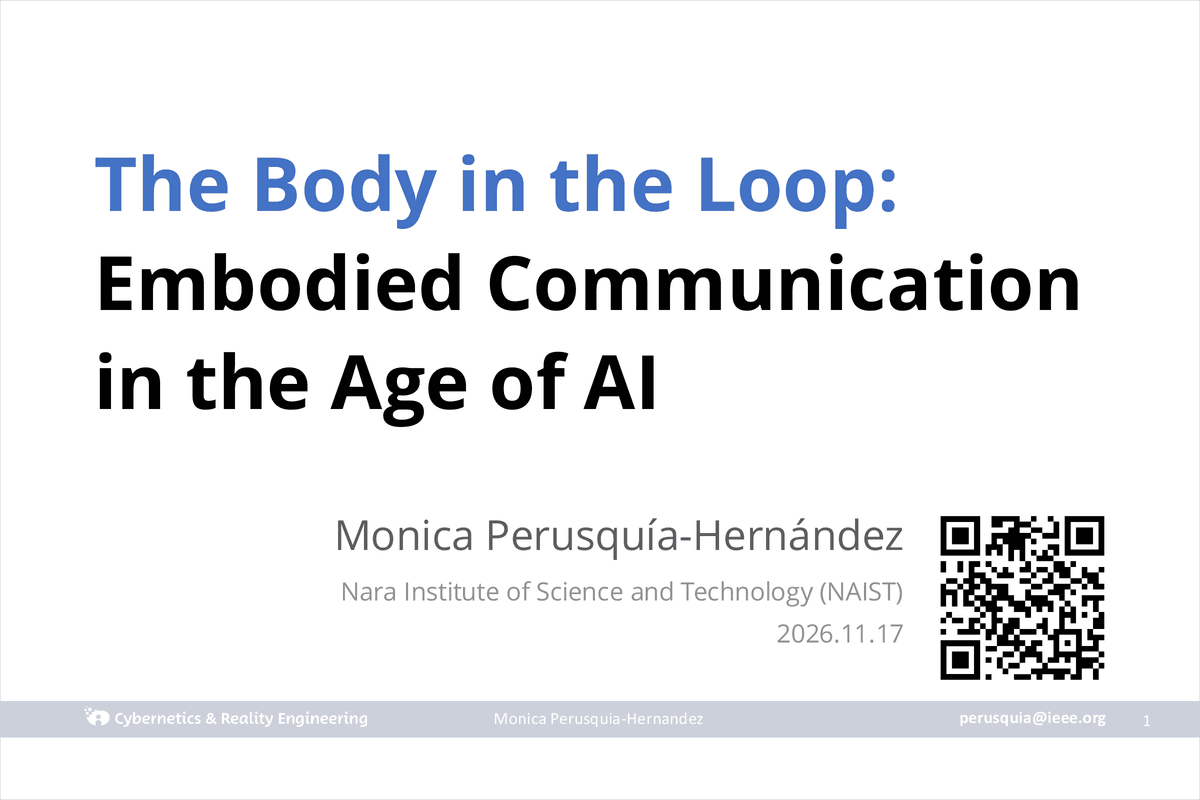
On 17 November 2026, Monica Perusquía-Hernández, assistant professor at the Nara Institute of Science and Technology (NAIST) in Japan, visited the group in Clausthal. Kai Kunze and the Institute of Informatics had invited her to give the institute’s colloquium. She spoke on “The Body in the Loop: Embodied Communication in the Age of AI” in the multimedia lecture hall Tannenhöhe and online.
Large language models now take part in communication, learning, emotional support and decision-making. They do so without direct access to the bodily experience that grounds human understanding. The talk asked what this decoupling means for interaction, and what people and machines gain when the body comes back into the loop.
Monica Perusquía-Hernández gave five reasons why the body matters: using the body stabilizes it, the state of the world affects mental performance, the body communicates, the body connects us, and body illusions complement emotion and cognition. She illustrated them with her research on biosensing, affective computing and virtual reality:
- Gaze can be estimated from electro-oculography even with the eyes closed, once the system is calibrated by pointing at targets (Sensors, 2025).
- DecluttAR, an augmented reality system, dims visual clutter on a desk to help people focus on their work (Augmented Humans 2023).
- A wearable reads facial muscle activity (EMG) and distinguishes spontaneous smiles from posed ones (IEEE Transactions on Affective Computing, 2017).
- Two people share one avatar in virtual reality, and haptic feedback changes their sense of agency and co-presence (CHI 2024).
- Virtual reality scenes elicit awe, and a first-person perspective does so more strongly than a third-person one (ICMI 2024).
- Large language models rate the emotion expressed in full-body movement with a distribution close to that of human raters (ICMI 2025 Companion).
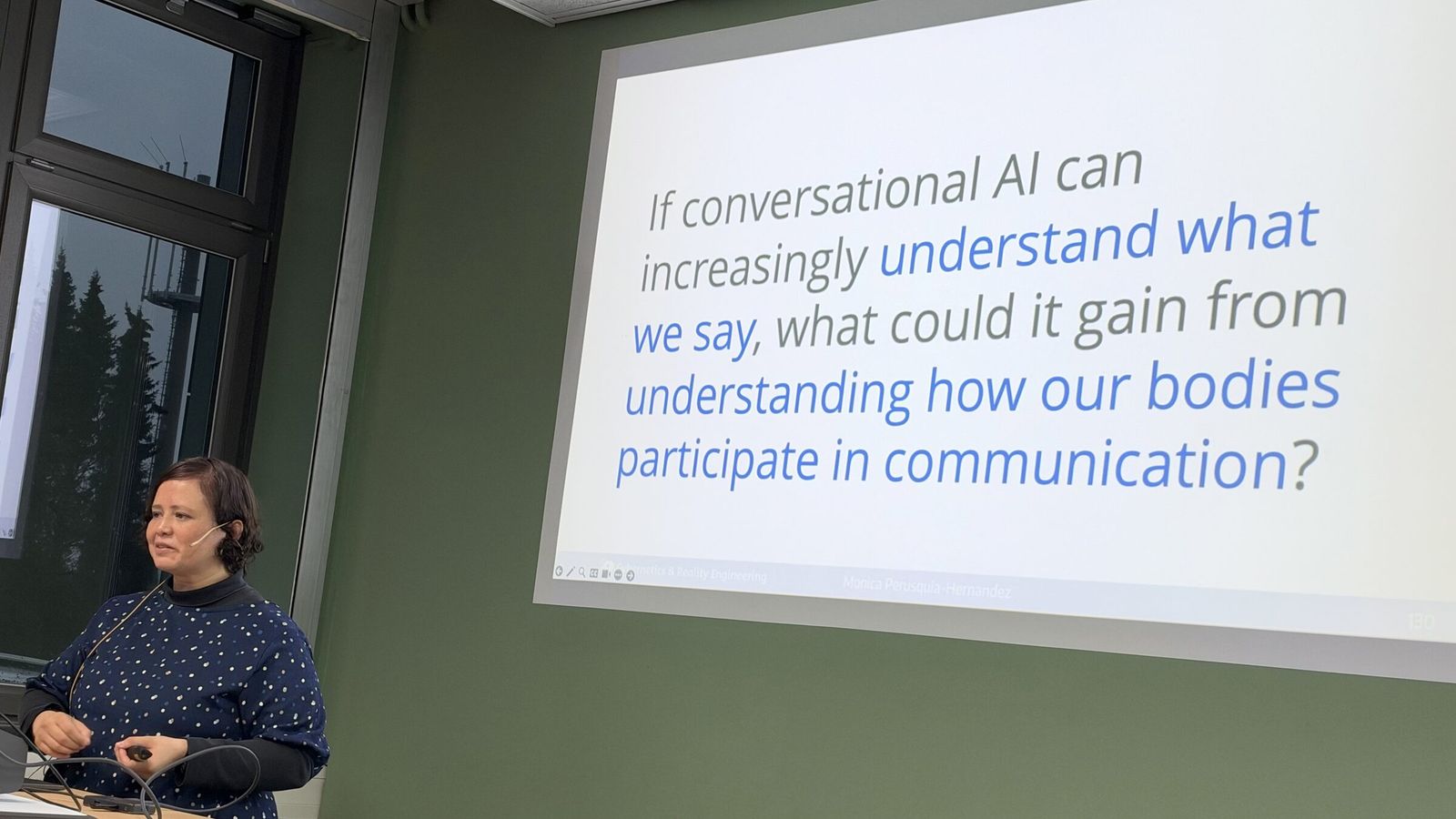
The talk closed with the question on the screen in the photo above: if conversational AI can increasingly understand what we say, what could it gain from understanding how our bodies participate in communication?
Monica Perusquía-Hernández studied electronic systems engineering at the Tecnológico de Monterrey in Mexico and human-technology interaction at Eindhoven University of Technology, where she also completed a professional doctorate in engineering. She received her PhD in Human Informatics from the University of Tsukuba in 2018. She is an Associate Editor of IEEE Transactions on Affective Computing. More on her website and on LinkedIn.
Many thanks to Monica for the visit and the talk.
Gallery
1 image