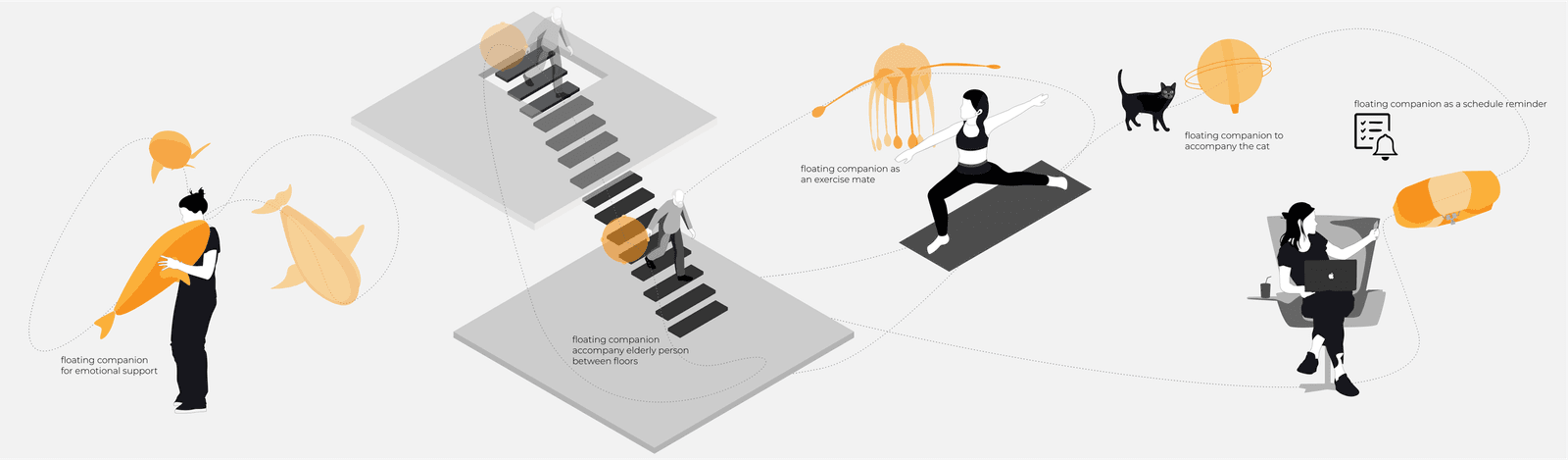
Our paper Floating Companion: Exploring Design Space for Soft Floating Robots in Indoor Environments won the Best Paper Award at DIS 2026 in Singapore. I am really happy for the team. Mingyang and Yanheng worked on it a long time, and it is nice to see it recognized.
Soft floating robots are lighter-than-air robots with soft, helium-filled bodies. Unlike the drones most people picture, they move through a room quietly, make gentle contact instead of avoiding it, and can hover above you without any downwash or noise. Their inflatable bodies can take almost any shape, from a fish to a cloud. The problem is that the research so far has been a scatter of one-off prototypes. Everyone builds their own thing, and there is no shared language for describing how these robots should move, behave, and interact with people. That makes it hard to get past cute demos.
So we sat down with 12 experts from HCI, HRI, design, and robotics, interviewed them, and worked through the transcripts. Out of that we built a design space with ten dimensions: spatial mobility scope, vertical floating mobility, spherical proxemics, interaction configuration, interaction targets, relationship roles, physical form, communication modalities, floating motion dynamics, and level of proactiveness. The interviews also gave us a set of application scenarios: emotional support and companionship, helping people communicate, setting an ambient mood in a room, assisting with daily tasks, and providing services in public spaces.
We did not want this to stay abstract, so we tied it back to physics. Helium-filled bodies have hard constraints, and we mapped those out in a Physics-Design Dependency Framework, then pulled three practical design principles from it: lean into soft physical contact, use the full 3D volume around a person, and design for animacy so the robot feels alive rather than mechanical. To show the design space actually produces things, we built proof-of-concept prototypes on a flapping-wing platform that put those principles into practice.
Era: GEIST lab, Graduate School of Media Design, Keio University, and TU Clausthal, Human-Centered Information Systems.
Source: kaikunze.de (22 June 2026).