Virtual reality promises to transport us to events we could never attend in person. Concert recreations in VR have become increasingly sophisticated, aiming to capture not just the sights and sounds of a performance, but the atmosphere created by a live audience. But what happens when we try to recreate that collective energy using physiological data from the original audience? And does it matter if that data is real or fake?
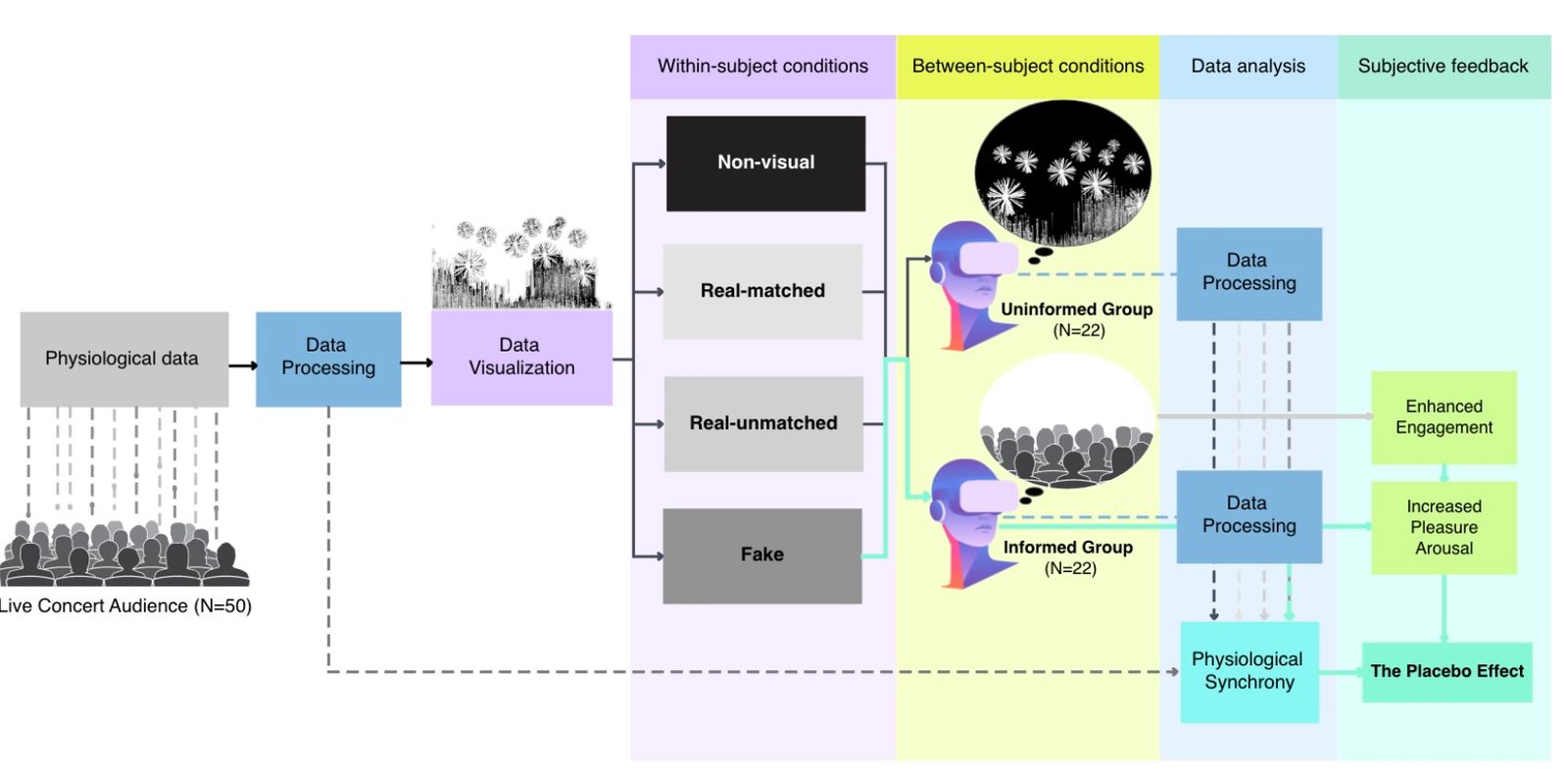
We recently conducted a study lead by Xiaru Meng that brings these questions into focus. The study centered on a classical piano concert recreation in VR. We collected electrodermal activity and blood volume pulse data from 50 audience members during a live performance. This data was then transformed into abstract 3D visualizations—organic forms resembling dandelions and grass that moved and scaled according to the physiological responses of the original audience. The experimental design compared four conditions: no visualization, real matched data from the actual concert, real unmatched data from a different performance, and randomly generated fake data. One group received no explanation about the visualizations. The other was told the visuals represented physiological data from previous audience members.
The informed group showed a different pattern entirely. Simply knowing that the visualizations represented other audience members increased engagement and co-presence across all conditions. In the informed group, the same fake data produced the highest levels of pleasure and arousal. Participants interpreted the rapid movement as indicating a highly engaged audience, which in turn made them feel more active and engaged themselves. Their bodies were responding as if they truly were experiencing the concert alongside an excited crowd, even though that crowd was entirely fictional.
For designers creating VR event recreations or social VR experiences, the findings suggest that providing context about visualizations matters more than ensuring perfect accuracy. From a research perspective, if user responses depend heavily on their beliefs about what the data represents, studies that fail to include placebo conditions may conflate genuine effects with expectancy-driven responses. The placebo concert demonstrates that in virtual worlds, what people believe about their experience can be as important as the technical systems supporting that experience.
Era: GEIST lab, Graduate School of Media Design, Keio University (2015 to 2026).
Source: kaikunze.de (10 January 2026).