Regular, analog glasses are already a great cognitive augment to us. If we put them on, we can see more clearly and, after a while, forget that we even wear them. Yet, even after the invention of what is considered the first digital, programmable computer (the ENIAC) 78 years ago, our digital tools are still lacking behind. PCs, smart phones and watches are distracting us, they are not the “Invisible Computing” that was promised to us.
To enable digital augments, tools that seamlessly help us in everyday tasks, the most critical limitations are no longer CPU speed, RAM, hard-drive space. The most critical are our cognitive limitations: our attention span, memory, and other cognitive properties. To understand these better, activity recognition for our mind is essential, towards A Cognitive “Quantified Self” or in other words Cognitive Activity Recognition.
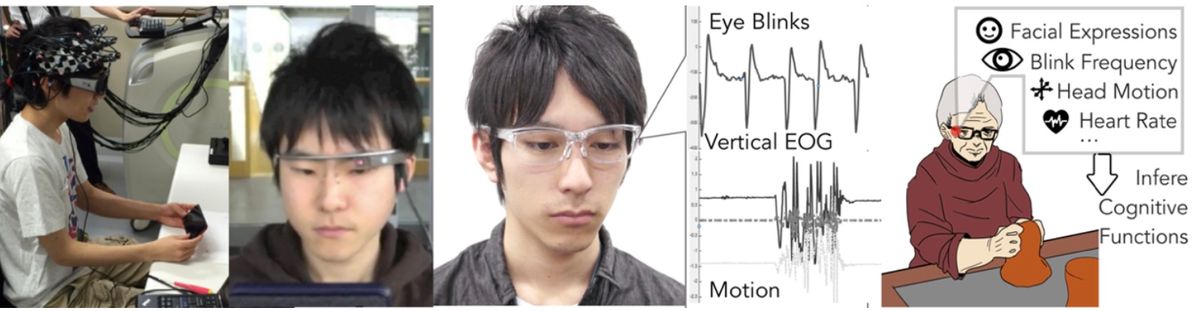
In terms of concept, Eyewear Computing seems to fit perfectly. As most of our senses are on the head, smart glasses could be the perfect cognitive assistants, simultaneously sensing cognitive states and providing cognitive aware interactions. Google Glass was a first very interesting exploration of the Eyewear Computing space. Implementing a simple blink detection, we can already receive some relevant information regarding cognitive states. The next platform we explored is J!NS MEME: a lightweight glass (ca. 35 grams) with inertial motion sensors and 3 electrodes embedded in the nose bridge for electrooculography. These lightweight glasses enable a completely new sensing and interaction space. They can be used to track alertness over the day. We can even use the electrodes to detect subtle nose touching gestures.
If Apple Vision Pro succeeds, it could usher in a renaissance for Eyewear Computing and a revolution in understanding our cognitive tasks and performance.
Era: GEIST lab, Graduate School of Media Design, Keio University (2015 to 2026).
Source: kaikunze.de (28 April 2023).
Gallery
2 images